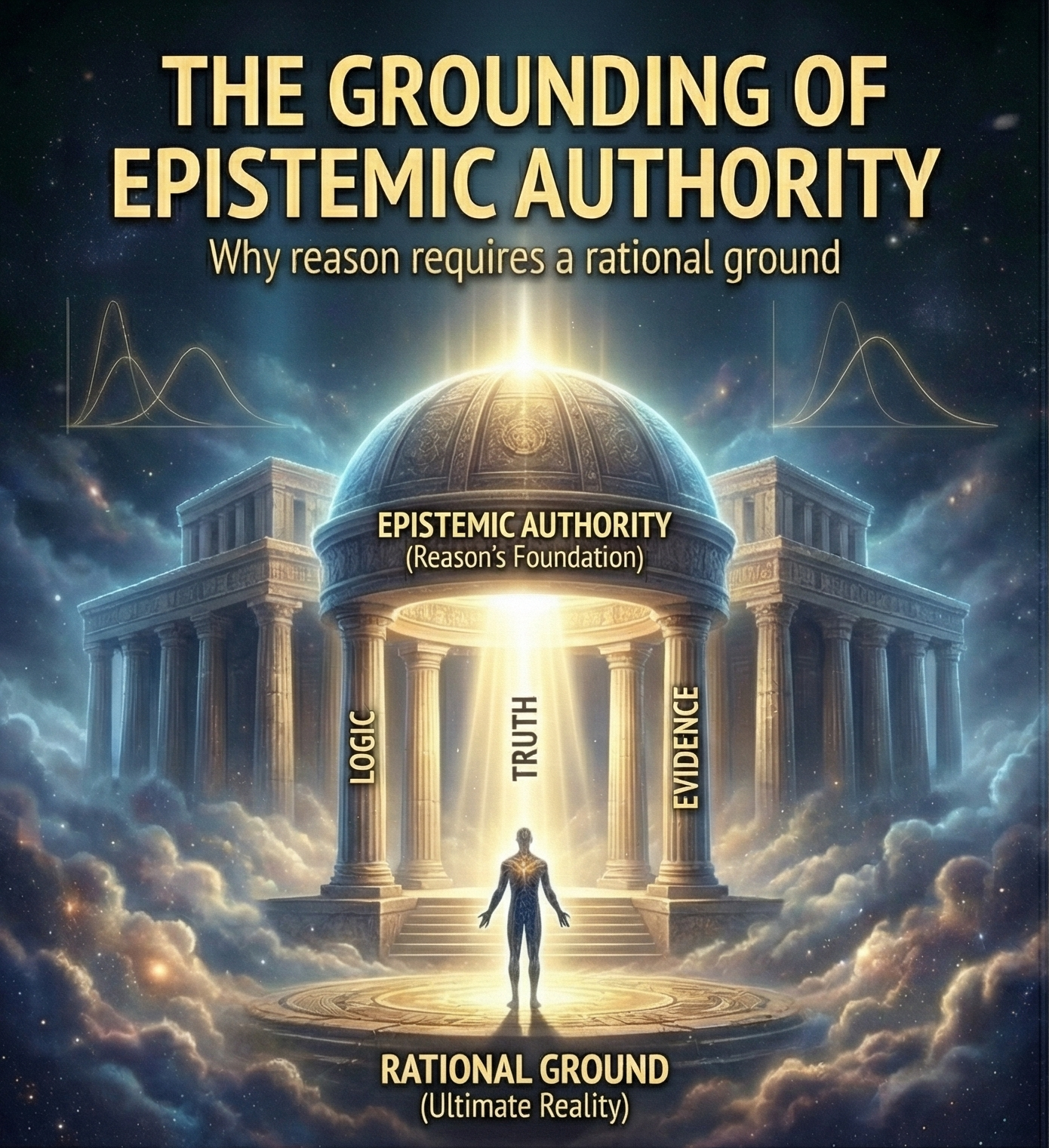
I. Definitions and Framework
Before examining the argument, we must be precise about what is meant by truth and justification.
Truth: A belief is true if it describes reality as it actually is, not merely if it is useful or adaptive. This is correspondence truth—the alignment of belief with reality.
Justification: Justification means normative epistemic authority—reasons why a belief ought to be accepted as correct, not merely explanations of how or why it is held.
These are not arbitrary definitions. They capture what we mean when we claim to know something genuinely, as opposed to merely possessing beliefs that happen to be useful or that we cannot help holding.
II. The Central Claim
If human reasoning is genuinely truth-aimed and justified in the normative sense, then the intelligibility, order, and law-like structure of reality cannot be adequately explained as brute facts.
Non-rational causal processes can explain why beliefs arise and why they may succeed behaviorally, but even when supplemented by reliability, function, practice, or emergence, they do not by themselves explain why any belief ought to be regarded as true rather than merely effective.
The gap identified here is ontological, not probabilistic. It concerns the source of epistemic normativity and authority, not the likelihood of belief success.
III. What Naturalistic Explanations Can and Cannot Provide
Consider what naturalistic accounts actually explain:
Evolutionary explanations can account for why organisms develop cognitive mechanisms that track regularities in their environment. Natural selection favors organisms whose perceptual and inferential systems correlate with survival-relevant features of the world.
Emergent complexity theories can explain how simple rules give rise to complex patterns and how higher-order regularities supervene on lower-level processes.
Reliability theories can describe how certain belief-forming processes consistently produce true beliefs under normal conditions.
These explanations are not false. They are explanatorily limited. They explain correlation between beliefs and reality. They explain behavioral success. They explain causal mechanisms of belief formation.
But they do not explain normative authority—why those beliefs are epistemically justified, why finite minds are answerable to logical and mathematical truths, or why reasoning itself has binding force.
IV. The Problem with Descriptive Structures
Some propose that abstract mathematical or logical structures—perhaps existing necessarily or as Platonic forms—constrain what is possible and thereby explain the order we observe.
This move helps with certain explanatory burdens, but it does not resolve the normative gap.
Descriptive structures, even necessary or Platonic ones, can constrain what is possible. They can describe what must be the case if certain conditions hold. But they are normatively inert: they do not, by themselves, ground why finite minds are answerable to those structures or why beliefs are obligated to conform to them.
Consider the law of non-contradiction. We can say it is necessarily true that contradictions cannot both obtain. But why should a mind care about conforming to it? Why does violating it constitute a rational failure rather than just a different way of thinking?
To treat such structures as epistemically authoritative either:
- Redefines justification in non-normative terms (justification becomes mere reliability or coherence, not genuine rational authority), or
- Treats normativity as brute and unexplained (there just is an irreducible fact that minds ought to conform to logic), or
- Presupposes the very rational authority under explanation (assumes that conforming to logical structure is what rationality means, without grounding why).
V. The Ontological Gap
The gap is not about probability or reliability. A belief-forming process can be highly reliable—it can produce true beliefs in the vast majority of cases—without thereby conferring normative justification.
Imagine a mechanism that generates true beliefs about the external world purely by accident, with no rational connection between the mechanism and the truth. Even if this mechanism were 99.9% reliable, we would not say the beliefs it produces are justified in the normative sense. The subject would be lucky, not rational.
Normative justification requires more than correlation or success. It requires that the belief be held for the right reasons—that the cognitive process is answerable to truth in a way that makes error a genuine failure and correctness a genuine achievement.
This is the structure of rational authority: it is not merely that beliefs track truth, but that they ought to track truth, and that the mind is obligated to revise beliefs in light of evidence, logic, and coherence.
VI. Why a Rational Ground Resolves the Gap
Positing a rational ground of reality—a necessarily existent, normatively authoritative source of both being and intelligibility—provides a more coherent and less revisionary explanation.
On this view:
- The structure of reality is not brute, but grounded in a rational nature.
- Logical and mathematical truths are not free-floating abstract objects, but reflections of the divine intellect.
- Finite minds are not accidents of matter, but created with the capacity to participate in rationality.
- The normativity of logic, mathematics, and inference is not mysterious, but flows from the fact that these structures are grounded in the ultimate rational authority.
Finite minds are answerable to logic and truth because they are derived from and oriented toward the rational ground of all being. Justification is not merely correlation with reality, but alignment with the rational structure that reality instantiates.
This is not an appeal to mystery. It is a structural explanation: normative authority is grounded in the normative nature of the ultimate reality. Just as causal explanations terminate in a first cause, epistemic explanations terminate in a first rational authority.
VII. Objections and Replies
Objection 1: "This just pushes the question back. Why should we accept the rational ground as authoritative?"
Reply: This objection misunderstands the nature of ultimate explanation. Every explanatory framework must terminate somewhere. The question is not whether there is an unexplained explainer, but whether that explainer is explanatorily sufficient and coherent. A rational ground explains epistemic normativity by being the kind of thing that can ground it—namely, a necessarily existent rational nature. To ask why rationality itself is authoritative is to presuppose rationality in the asking.
Objection 2: "Naturalism can account for normativity through social practice, evolutionary pressure, or coherence constraints."
Reply: These accounts explain why we treat certain norms as binding, or why conforming to them is advantageous, but they do not explain why those norms are binding in a non-conventional sense. Social practice explains consensus, not truth. Evolutionary pressure explains adaptive advantage, not rational obligation. Coherence constraints explain internal consistency, not correspondence with reality. None of these grounding strategies escape the gap between descriptive causation and normative authority.
Objection 3: "This is just an argument from ignorance. We don't yet know how naturalism grounds normativity, but that doesn't mean it can't."
Reply: This is not an argument from ignorance but an argument from explanatory structure. The claim is not that naturalism has failed to explain normativity yet, but that the kind of explanation naturalism offers—causal, non-normative, descriptive—is categorically insufficient for grounding normative epistemic authority. It is not a gap that more research will close; it is a gap between different kinds of explanation.
VIII. What This Means for Belief in God
If the argument is sound, then affirming the reliability of human reasoning—our capacity for logic, mathematics, science, and inference—commits us to a rational ground of reality.
One cannot coherently maintain both:
- That human reasoning is genuinely truth-aimed and normatively justified, and
- That reality is ultimately grounded in non-rational, non-normative processes or brute facts.
To trust reason is to presuppose that reality is fundamentally intelligible and that minds are rightly ordered toward truth. But intelligibility and rational ordering do not arise from blind causation. They require a rational ground.
This does not prove every attribute traditionally ascribed to God. But it does establish that the ground of being must be rational, normatively authoritative, and the source of epistemic justification. These are not incidental features. They are essential to any account of knowledge that takes truth and justification seriously.
IX. Conclusion
Reason does not justify itself. The authority of logic, the bindingness of mathematical truth, and the normativity of epistemic justification all require grounding.
Naturalistic explanations—evolutionary, emergent, or structural—can account for belief formation, reliability, and correlation with reality. But they cannot account for normative authority: the fact that beliefs are answerable to truth, that minds ought to conform to logic, and that error is a genuine rational failure.
A rational ground of reality—necessarily existent, normatively authoritative, and the source of both being and intelligibility—provides the explanatory foundation that naturalism lacks.
Rejecting this conclusion does not refute the conditional. It requires either:
- Abandoning correspondence truth,
- Denying epistemic normativity, or
- Treating rational authority as brute and unexplained.
The choice is stark:
Either reason is grounded in a rational reality,
or reason has no ground at all.
If we take knowledge seriously—if we affirm that our beliefs can be genuinely true and genuinely justified—then we are committed to a reality that is rationally structured at its foundation.
That is not theology imposed on philosophy.
It is philosophy followed to its rational conclusion.