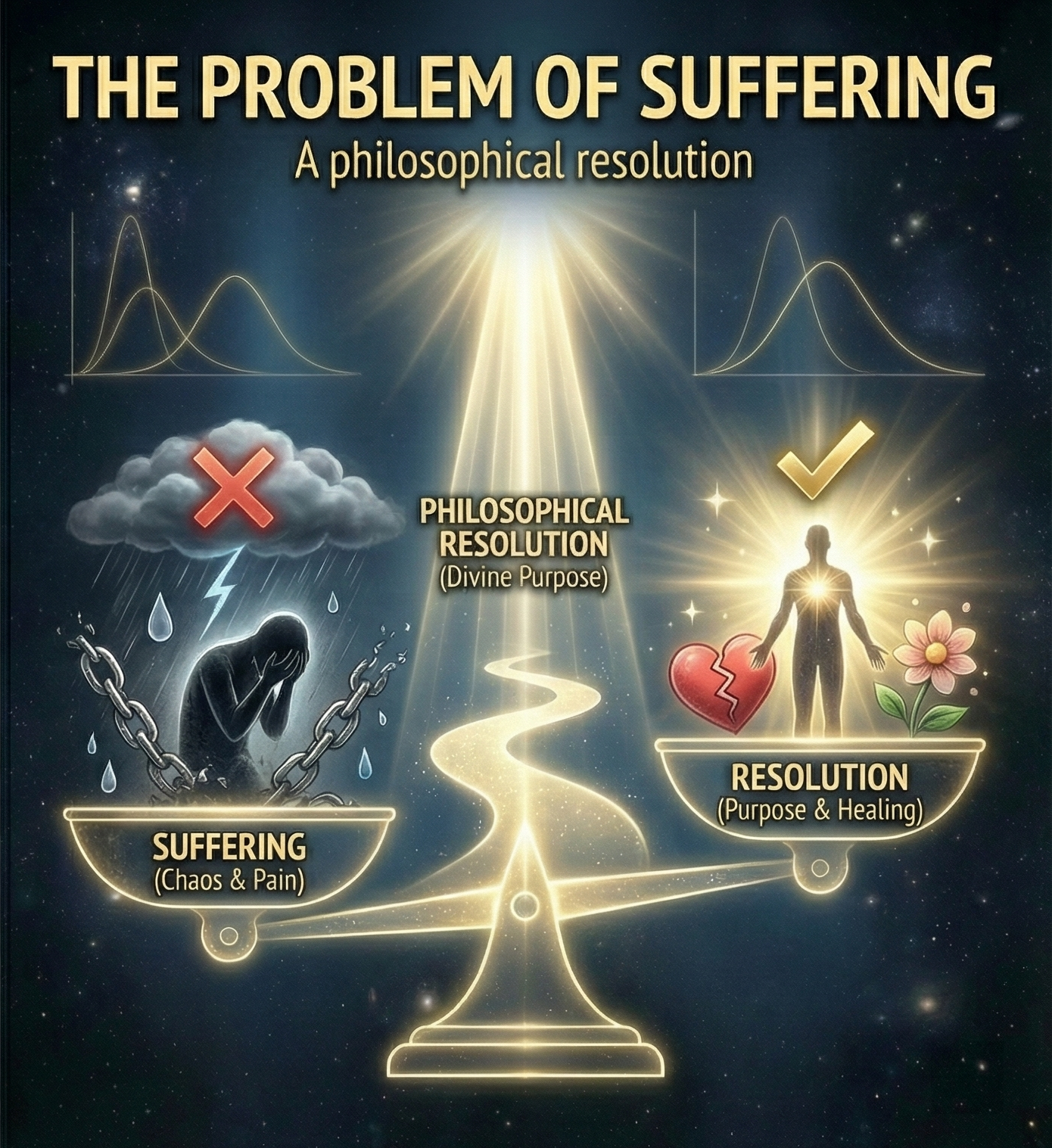
I. The Problem
The problem of suffering is commonly treated as evidence against the existence of a benevolent God. The reasoning is straightforward: if God is perfectly good and omnipotent, unnecessary suffering should not exist; suffering does exist; therefore either God does not exist or is not good.
This argument appears compelling only because it relies on a particular conception of suffering—one that treats suffering as final, identity-defining, imposed, and epistemically transparent. Once those assumptions are examined, the force of the argument dissolves.
II. Suffering Is Not a Unitary Concept
Suffering is often conflated with pain, but the two are not identical.
- Pain is a phenomenal or physiological event.
- Suffering is pain that is integrated into personal identity through memory, narrative, and meaning.
This distinction is already embedded in ordinary moral practice. Pain experienced under anesthesia is not treated as enduring harm. Trauma that is fully healed is not reckoned as ongoing injury. What matters morally is not merely that pain occurs, but whether it persists as part of the self.
Suffering can therefore be real without being permanent, intense without being ultimate.
III. Agency Requires Stakes
A world without the possibility of suffering would be a world without genuine agency.
Risk, loss, sacrifice, courage, compassion, and responsibility all presuppose the possibility of harm. A world in which nothing can go wrong is not morally richer; it is morally flatter. Choice without consequence collapses into preference expression.
Suffering is not good, but the possibility of suffering is a necessary condition for meaningful action in a finite world.
IV. Finitude and Voluntary Limitation
If persons exist who are more than momentary biological events—if they are enduring subjects—then finitude itself requires explanation.
Certain forms of value cannot exist in a state of invulnerability or completion. Fear requires vulnerability. Courage requires danger. Compassion requires exposure to loss. An eternal being cannot undergo these experiences unless it accepts limitation.
It is therefore coherent to understand finite life not as a punishment imposed, but as a condition entered into. Limitation is not a defect if it is voluntarily assumed for the sake of experiences unavailable in an unlimited state.
V. Memory, Identity, and Restoration
The moral weight of suffering depends decisively on whether it is preserved.
Pain that becomes part of enduring personal identity is grave. Pain that is erased, healed, or never narratively integrated does not remain as harm to the person who persists beyond it.
This is not speculative. It is precisely how anesthesia functions: distress may occur at the level of momentary consciousness, but no suffering is carried forward into the enduring self. We do not regard such pain as identity-defining injury.
If suffering can be healed, erased, or transfigured—if it does not survive into the final accounting of the self—then it is not ultimate. What is not ultimate cannot serve as a decisive objection to the goodness of the whole.
VI. Epistemic Limitation and Misjudgment
Judgments made from within an experience need not be accurate judgments of the whole.
A patient under anesthesia may believe herself tortured and accuse the surgeon of cruelty. The judgment is sincere and understandable—and false. Consent existed, harm was not intended, and the suffering did not persist.
Finite beings occupy a similarly constrained epistemic position. Judging the total structure of existence from within a local, temporary, and memory-limited phase is not a reliable standpoint for ultimate evaluation.
This does not diminish the reality of suffering within the experience. It explains why suffering does not exhaust the truth about the whole.
VII. Unequal Suffering Follows from Individuality
Distinct lives cannot be lived identically. Differences in capacity, circumstance, relationship, and choice necessarily produce differences in risk and loss.
Unequal suffering is not a moral defect to be explained away; it is a logical consequence of individuality. Justice does not require sameness of experience. It requires that no one is permanently lost, abandoned, or condemned to infinite harm.
A world of genuinely distinct persons cannot be a world of equal difficulty.
VIII. Comparison with Annihilation
Those who deny any form of persistence beyond death typically hold that consciousness ends entirely. On that view, suffering is finite, remembered by no one, and carried forward by no enduring subject.
If annihilation renders suffering moot, then finite suffering followed by restoration cannot be morally worse. The objection from suffering cannot be deployed selectively against theism while exempting nihilism. Either suffering disqualifies all worldviews, or it disqualifies none by itself.
IX. Conclusion
The problem of suffering derives its force from treating suffering as final, identity-defining, unchosen, and unredeemable.
Once suffering is understood as:
- arising largely from finite agency and mortality,
- inseparable from the conditions of meaningful action,
- limited in duration,
- and subject to healing, erasure, or restoration,
it no longer functions as evidence against the existence of a benevolent God.
Suffering remains real within life. It demands compassion, resistance, and alleviation. But it does not possess the metaphysical authority to pronounce on the nature of all reality.
The existence of suffering does not refute divine goodness.
It reveals the cost of finitude.
That is not a failure of coherence.
It is the structure of a world where meaning is possible.