Chapter 3: Semiotic Hierarchies
"The heavens declare the glory of God, and the sky above proclaims his handiwork."
— Psalm 19:1, ESV
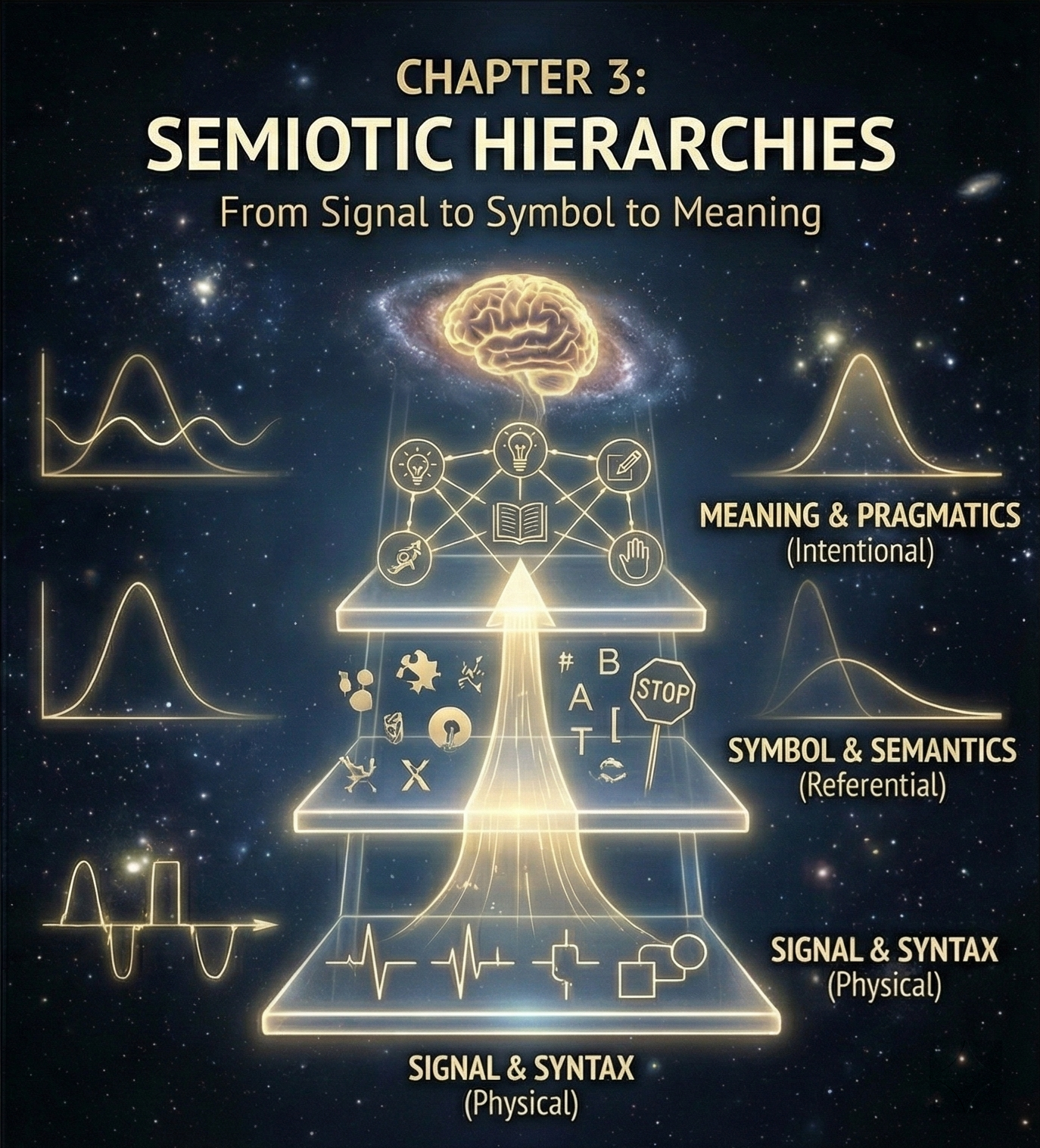
Charles Sanders Peirce's triadic semiotic framework—sign, object, referent—reveals why symbolic systems constitute the most unambiguous evidence of intelligent causation. Unlike dyadic physical relationships governed by natural law, triadic semiotic relationships require a mediating interpreter to establish the connection between sign and object.
The genetic code exemplifies this semiotic irreducibility. DNA codons function as signs, amino acids as objects, and the ribosomal translation machinery as interpreter. The relationship between codon UUU and phenylalanine exhibits no physical or chemical necessity—it is purely conventional, established and maintained by the interpretive apparatus of the cell.
Hubert Yockey's information-theoretic analysis demonstrates that the genetic code constitutes a genuine language, complete with syntax (codon structure), semantics (amino acid assignments), and pragmatics (functional protein outputs). Like human languages, it exhibits the arbitrary but systematic mapping between symbols and meanings that characterizes all linguistic systems.
Nothing here requires that biological codes be maximally arbitrary. In practice, symbol systems often exploit underlying regularities or constraints—ink and paper chemistry, phonetic similarities, ease of articulation. The point is not that any mapping is equally likely; it's that no amount of low-level constraint, by itself, yields the full triad of symbol-syntax-semantics. Even if stereochemical affinities or evolutionary path-dependence narrow the space of viable codon-to-amino-acid mappings, they don't explain: why any particular mapping is treated as the correct one by the system, how the mapping is stably maintained and interpreted, or how the system comes to have goal-directed functions such as building a functioning protein. Those are hallmarks of a semantic, not merely chemical, architecture.
This semiotic structure generates what we might term 'interpretive irreducibility'—the impossibility of reducing meaning to purely physical causation. Physical processes can transmit and modify information, but they cannot create the semantic relationships that give information its meaning. Meaning requires an interpreter capable of recognizing symbols as symbols rather than mere physical patterns.
The hierarchical organization of biological information systems reinforces this semiotic analysis. DNA sequences encode instructions for RNA synthesis. RNA sequences encode instructions for protein synthesis. Protein structures encode instructions for enzymatic function. Each level exhibits its own syntax and semantics while interfacing systematically with adjacent levels.
Eugene Koonin's comparative genomics reveals additional layers of semiotic complexity. Regulatory networks exhibit modular organization, with transcription factors functioning as biological 'switches' that respond to environmental inputs. These networks implement sophisticated logic operations—AND gates, OR gates, feed-forward loops, bistable switches—that process information with the precision of designed computational systems.
The emergence of epigenetic regulation adds yet another semiotic layer. Histone modifications, DNA methylation patterns, and chromatin remodeling complexes function as a secondary code overlaying the primary genetic code. This 'code above the code' regulates gene expression through mechanisms that are themselves encoded, creating recursive semiotic hierarchies of staggering complexity.
Perhaps most significantly, biological semiotic systems exhibit what Douglas Hofstadter terms 'self-reference'—the capacity to encode information about their own structure and function. Genes encode the proteins required for their own transcription and translation. Regulatory circuits control their own regulation. The entire system exhibits the kind of reflexive sophistication that characterizes conscious intelligence.
This self-referential structure becomes particularly evident in the phenomenon of biological error correction. DNA repair mechanisms detect and correct transcription errors using redundant encoding strategies. Chaperone proteins ensure correct protein folding through mechanisms that themselves require correct folding. The cell implements quality control systems that monitor the quality control systems themselves.
Such recursive semiotic architectures resist materialist reduction because they presuppose the very interpretive capabilities they seek to explain. The ribosome that translates genetic information is itself specified by genetic information. The DNA repair systems that maintain genetic integrity are themselves genetically specified. The emergence of such interpretive circularities through undirected processes would require the spontaneous generation of meaning from meaninglessness—a logical impossibility that no amount of time or probabilistic resources can overcome.
The semiotic analysis thus reveals biological systems as paradigmatic examples of designed information processing architectures: hierarchically organized, semantically coherent, interpretively irreducible, and reflexively self-maintaining. These characteristics converge to create an informational signature that unambiguously indicates intelligent causation.