Chapter 6: Cosmic Architecture
"By the word of the Lord the heavens were made, and by the breath of his mouth all their host."
— Psalm 33:6, ESV
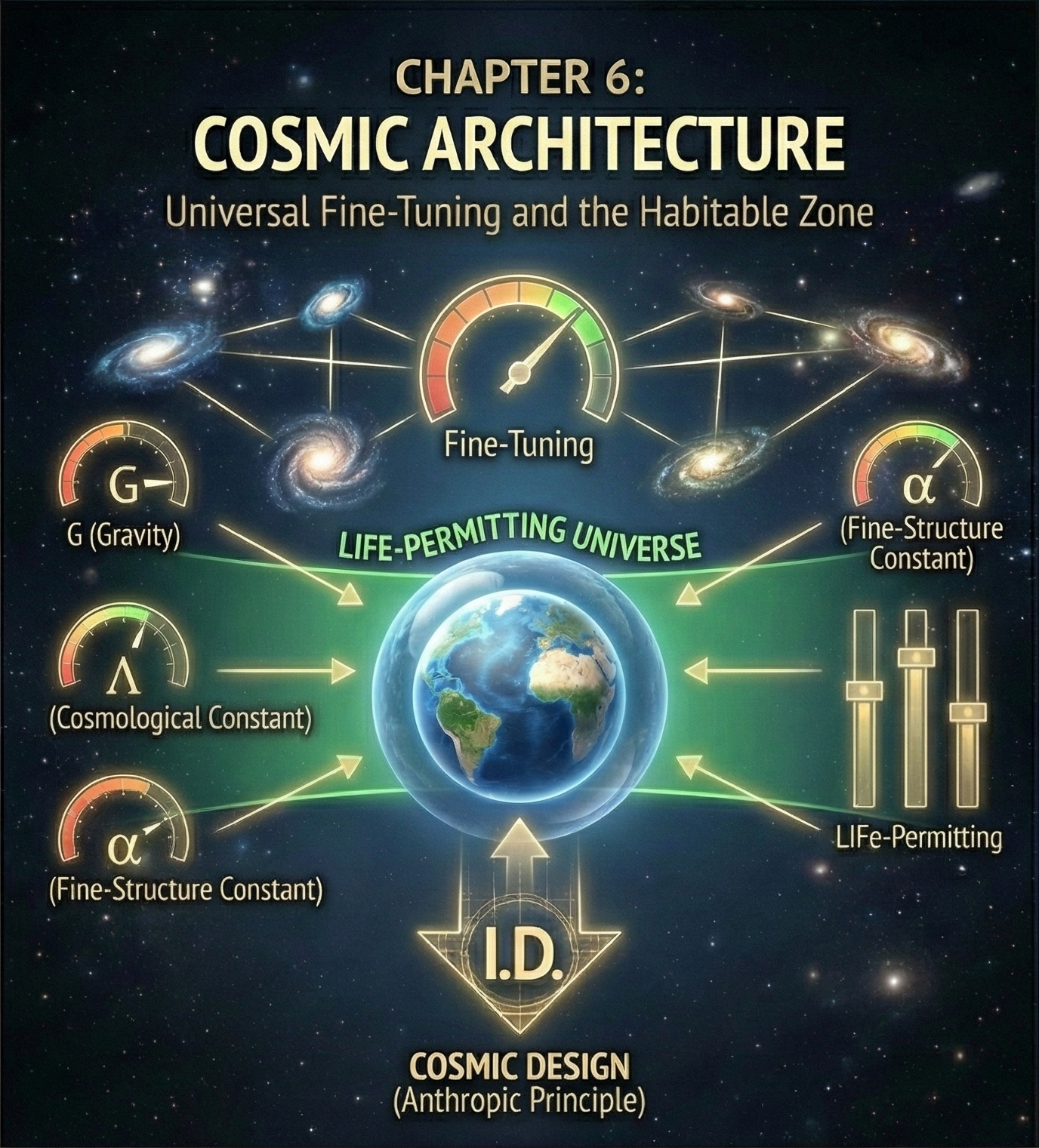
The anthropic principle reveals the universe as a vast information-processing system calibrated with extraordinary precision to permit the emergence of complexity, consciousness, and comprehension. This cosmic fine-tuning extends far beyond the molecular machinery of biological systems to encompass the fundamental parameters that govern the behavior of matter, energy, space, and time themselves.
Steven Weinberg's analysis of the cosmological constant exemplifies the depth of this fine-tuning problem. The vacuum energy density, expressed as the cosmological constant Λ, determines the universe's expansion rate and ultimate fate. As Weinberg and others have emphasized, the naive quantum field theory prediction overshoots the observed value by approximately 120 orders of magnitude—widely regarded in the literature as a striking tension between theory and observation, whatever one's metaphysics. This is not a literal probability of universes; rather, it's a comparison between predicted vacuum energy and the observed bound, used to illustrate the fine-tuning discussion.
This tension reveals something significant about cosmic architecture. The observed value of Λ falls within an extraordinarily narrow range that permits galaxy formation while avoiding immediate collapse or runaway expansion. Values just slightly larger would prevent gravitational condensation of matter into stars and galaxies. Values significantly smaller would cause universal collapse before stellar nucleosynthesis could produce the heavy elements necessary for complex chemistry.
The fine-tuning extends systematically across all fundamental forces and constants. Paul Davies catalogues dozens of anthropic coincidences that individually exhibit improbabilities comparable to the cosmological constant problem. The strong nuclear force requires calibration within 1% to permit both stellar nucleosynthesis and stable atomic nuclei. The electromagnetic coupling constant must fall within narrow bounds to permit chemical bonding while avoiding electromagnetic runaway processes.
Perhaps most remarkably, the mass difference between protons and neutrons—a mere 0.14%—determines the abundance of hydrogen in the universe, which in turn controls the rate of stellar fusion and the lifetime of stars. Slightly larger mass differences would eliminate stable hydrogen, preventing stellar formation entirely. Slightly smaller differences would rapidly convert all hydrogen to helium during Big Bang nucleosynthesis, eliminating the fuel for stellar evolution.
Fred Hoyle's prediction and subsequent discovery of the carbon-12 resonance level provides a paradigmatic example of anthropic reasoning in cosmology. Hoyle recognized that carbon production in stellar cores requires an extraordinary coincidence: the energy levels of carbon-12, oxygen-16, and beryllium-8 must be precisely coordinated to permit carbon synthesis while avoiding immediate destruction through oxygen formation. The required energy level, later discovered and termed the 'Hoyle state,' exhibits exactly the properties Hoyle predicted based purely on anthropic considerations.
When multiple independent fine-tuning conditions must be satisfied simultaneously, their combined stringency generates a design signature that becomes increasingly difficult to attribute to chance. Roger Penrose's calculation of the entropy constraints on the early universe, for instance, yields a phase-space volume ratio on the order of 1 in 10^10^123—illustrating how deeply the initial conditions are separated from generic values in the model. Even if one considers these estimates uncertain by many orders of magnitude, the basic point stands: these are not generic outcomes under models restricted to unguided natural processes, relative to the probabilistic resources of our observable universe.
The multiverse hypothesis attempts to dissolve these improbabilities through appeal to infinite ensemble generation, but such proposals face insurmountable conceptual and empirical difficulties. Andrei Linde's chaotic inflation models require precise fine-tuning of the inflation potential to generate universe-producing fluctuations rather than quantum noise. String theory landscapes demand miraculous coincidences in the distribution of flux configurations to populate anthropically viable regions of the parameter space.
More fundamentally, Max Tegmark's mathematical universe hypothesis—the ultimate expression of multiverse thinking—reduces physical reality to mathematical structure, raising profound questions about the ontological status of observers within purely formal systems. If consciousness represents nothing more than complex information processing within mathematical structures, the anthropic argument becomes circular: we observe fine-tuning because we are the types of structures that can only exist in fine-tuned mathematical frameworks.
The design inference provides a more empirically grounded explanation for cosmic fine-tuning by recognizing the universe itself as an engineered system optimized for specific outcomes. Just as human engineers calibrate multiple independent parameters to achieve desired functionality, cosmic fine-tuning suggests coordination among fundamental constants to achieve the specific outcome of observer-permitting complexity.
This engineering interpretation gains support from the hierarchical structure of cosmic design. The same mathematical principles that govern optimal engineering solutions—minimization principles, symmetry constraints, dimensional analysis—appear throughout the fundamental laws of physics. The Standard Model exhibits precisely the gauge symmetries required for renormalizable field theories. General relativity represents the unique extension of special relativity to curved spacetime that preserves the principle of general covariance.
The mathematical elegance of physical law suggests that the universe operates according to principles of rational design rather than arbitrary historical contingency. Eugene Wigner's famous essay on 'The Unreasonable Effectiveness of Mathematics in the Natural Sciences' highlights the profound mystery that mathematical structures discovered through pure logical analysis correspond precisely to the deep structure of physical reality.
This correspondence between mathematical beauty and physical truth points toward what we might term 'noetic fine-tuning'—the calibration of natural law to permit mathematical comprehension by finite minds. The fact that human mathematicians can discover and understand the equations that govern cosmic evolution suggests that the universe has been structured in a way that makes rational comprehension possible.
Such noetic fine-tuning transcends mere anthropic coincidence to reveal cosmic purpose. A universe designed merely to permit biological evolution might exhibit the minimal fine-tuning necessary for complex chemistry. But a universe calibrated to permit mathematical understanding suggests a cosmic architecture intended to be comprehended by rational observers—a cosmos designed as much for contemplation as for habitation.