Chapter 5: The Regression Problem
"Before the mountains were brought forth, or ever you had formed the earth and the world, from everlasting to everlasting you are God."
— Psalm 90:2, ESV
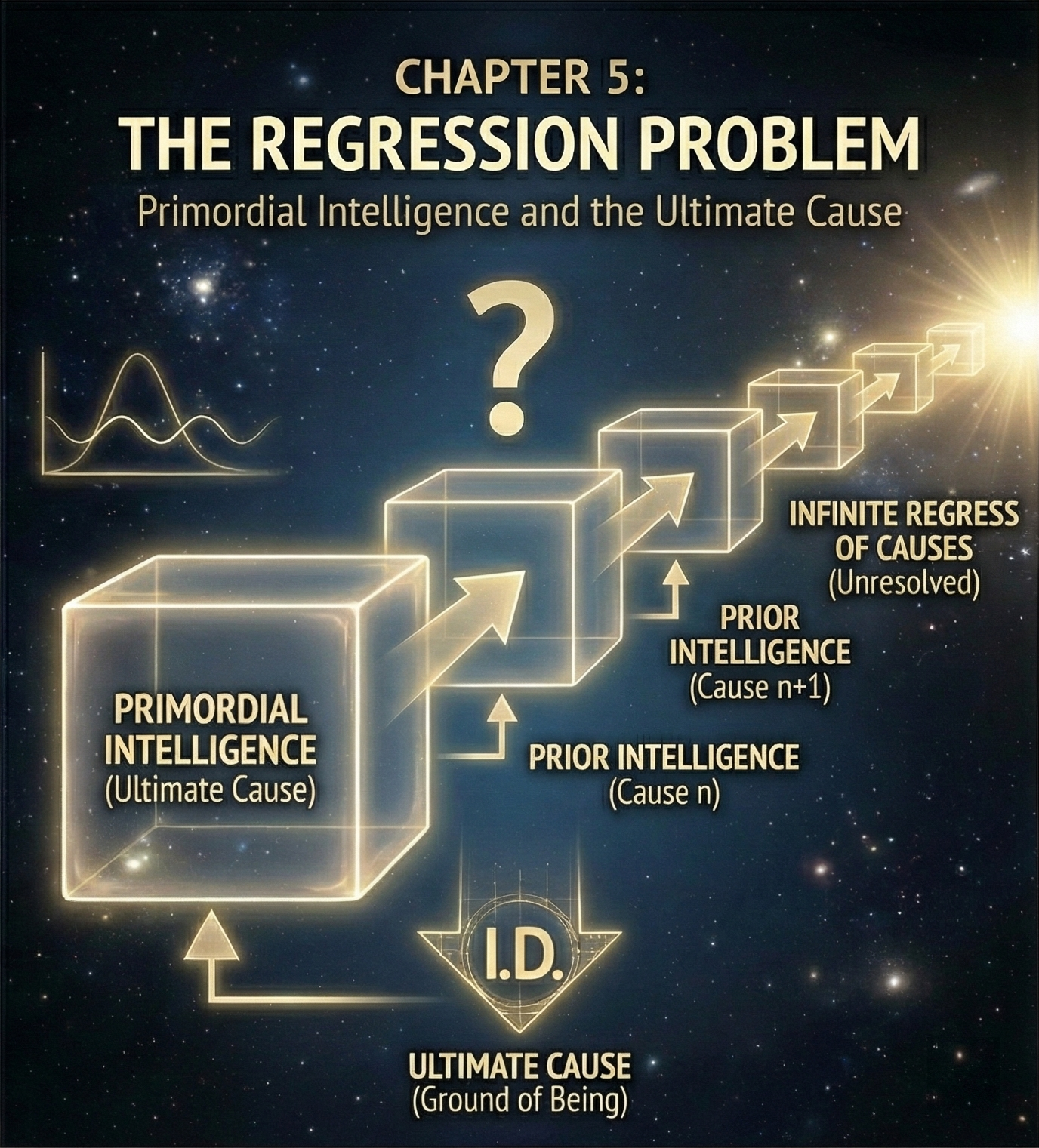
The detection of intelligent design inevitably raises what philosophers term 'the regression problem': if complex biological systems require intelligent causation, what explains the origin of the intelligence itself? This question proves more philosophically sophisticated than the reflexive 'who designed the designer?' objection suggests, demanding careful analysis of the logical structure of causal explanation and the metaphysical requirements for terminating infinite regress.
Aristotle's analysis of efficient causation establishes the impossibility of infinite causal chains in simultaneously ordered series. While accidentally ordered series (parent-child genealogies) can theoretically extend infinitely backward in time, essentially ordered series (hand-stick-stone) require a primary unmoved mover to initiate causal activity. The distinction proves crucial for understanding why designed biological systems point toward a necessarily existent first intelligence rather than an infinite regress of contingent designers.
Contemporary proposals for extraterrestrial intelligence as the source of biological design merely relocate the problem without resolving it. Francis Crick and Leslie Orgel's directed panspermia hypothesis suggests that life on Earth originated through deliberate seeding by advanced alien civilizations. But this proposal fails to address the origin of the aliens themselves, creating what we might term 'explanatory displacement' rather than genuine explanation.
The thermodynamic constraints analyzed in Chapter 4 apply universally to any material intelligence, regardless of its evolutionary history or technological sophistication. Any finite intelligence capable of designing biological systems must itself be a complex information-processing system subject to entropic decay. Such systems require continuous energy input to maintain their organizational integrity, pointing toward the need for external causal support.
Moreover, the semiotic irreducibility demonstrated in Chapter 3 reveals that meaning itself cannot emerge from purely physical processes, regardless of their complexity or temporal duration. The capacity to recognize and manipulate symbols presupposes interpretive capabilities that transcend mechanistic causation. Even superintelligent alien civilizations would face the same foundational problem: the emergence of semantic content from syntactic manipulation remains logically impossible within purely materialist frameworks.
The fine-tuning evidence compounds this regression problem exponentially. The anthropic coincidences that permit the existence of complex chemistry extend far beyond biological compatibility to encompass the fundamental constants that govern cosmic evolution itself. The precise values of the cosmological constant, the strong nuclear force, the electromagnetic coupling constant, and dozens of other parameters appear calibrated to extraordinary precision to permit the formation of galaxies, stars, planets, and ultimately observers.
Robin Collins' calculation of the 'epistemic probability' for fine-tuning demonstrates that the likelihood of a life-permitting universe arising by chance falls below 1 in 10^53—a probability so vanishingly small that it effectively represents logical impossibility. Yet any alien intelligence capable of designing terrestrial life would itself require a fine-tuned universe to evolve and survive.
This creates what we might term 'the nested dependency problem': designed biological systems presuppose designed alien intelligence, which presupposes designed cosmic fine-tuning, which presupposes designed physical laws, which presupposes designed mathematical structures. Each level of explanation depends on prior levels of design, generating an infinite regress that can only be terminated by a necessarily existent intelligence that transcends the contingent order entirely.
The philosophical requirements for such a first intelligence become apparent through modal logical analysis. Contingent beings—those that could either exist or not exist—cannot serve as ultimate explanations because their own existence requires explanation. Only a necessarily existent being—one whose non-existence is logically impossible—can terminate the explanatory regress without circularity.
Alvin Plantinga's modal version of the ontological argument demonstrates that if necessary existence is possible, then necessary existence is actual. The argument's validity turns on the coherence of maximal greatness, which includes necessary existence as an essential property. Recent work in modal semantics by Alexander Pruss and Joshua Rasmussen has strengthened the logical foundation for this inference, showing that the principle of sufficient reason, properly formulated, requires the existence of a necessarily existent explanatory ultimate.
The informational signature of biological design thus points beyond the material cosmos toward a transcendent intelligence that exists necessarily rather than contingently. This intelligence must possess several crucial characteristics: it must be capable of instantiating specified complexity in material systems; it must exist independently of thermodynamic constraints; it must be the source of semantic content rather than merely its manipulator; and it must be metaphysically prior to the physical cosmos itself.
Such characteristics align precisely with classical theistic conceptions of divine intelligence: eternal, immutable, simple, and necessarily existent. The design inference, rigorously applied, does not terminate in finite extraterrestrial intelligence but in infinite primordial intelligence—the uncaused cause of all contingent complexity and the ultimate source of the information that structures reality at every level.