Conclusion: The Impossibility of Unguided Complexity
"The fool says in his heart, 'There is no God.' They are corrupt, they do abominable deeds; there is none who does good."
— Psalm 14:1, ESV
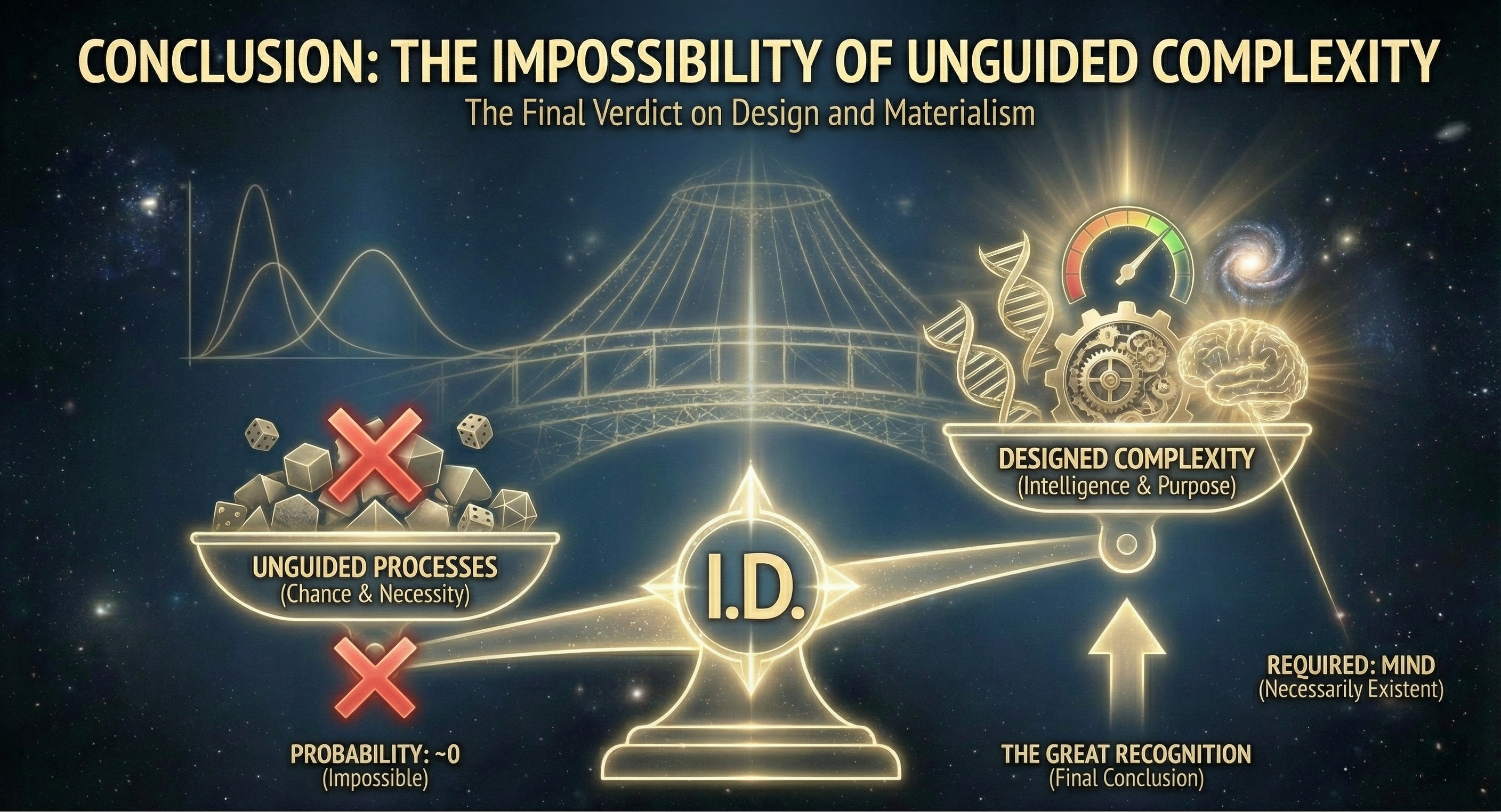
The cumulative weight of evidence surveyed across these chapters presents a staggering challenge to naturalistic explanations of reality. We have examined the mathematical impossibilities embedded in even the simplest biological systems, the thermodynamic constraints that prohibit spontaneous information generation, the semiotic irreducibility of symbolic systems, and the fine-tuning requirements that permit the existence of complexity itself. The convergence of these independent lines of evidence creates a probabilistic deficit so vast that it transcends rational credibility.
Consider the magnitude of improbabilities we have documented:
Molecular Biology: Douglas Axe's experiments demonstrate that functional proteins exhibit specificity requirements approaching 1 in 10^164. Stephen Meyer's analysis of DNA information content reveals that the shortest known free-living bacterium contains 159,662 base pairs encoding 182 protein-coding genes—each precisely specified for cellular function. The probability of assembling such informational complexity through undirected processes falls below 1 in 10^41,000.
Biochemical Systems: Michael Behe's documentation of irreducible complexity reveals molecular machines requiring simultaneous coordination of dozens of protein components. The bacterial flagellum alone demands precise integration of approximately 30 proteins, each individually non-functional, generating compound improbabilities that dwarf the probabilistic resources of the observable universe.
Genetic Code Optimization: The universal genetic code exhibits error-minimization properties that rank in the top 0.1% among 10^20 possible alternatives. This optimization requires global coordination across the entire translation apparatus—a level of systematic integration that exceeds any known natural process.
Cosmological Fine-Tuning: The anthropic constants governing cosmic evolution require simultaneous calibration to precisions that individually approach 1 in 10^120. Roger Penrose's entropy calculations for the early universe generate improbabilities on the order of 1 in 10^10^123. The cosmological constant, strong nuclear force, electromagnetic coupling, and gravitational constant must all fall within extraordinarily narrow ranges to permit the formation of galaxies, stars, and chemical complexity.
Consciousness and Rationality: The emergence of subjective experience, mathematical insight, and rational comprehension requires fine-tuning of quantum coherence mechanisms in neural tissue, coupled with the deeper mystery of how semantic content can arise from purely syntactic manipulation. The correspondence between mathematical structures in conscious minds and mathematical structures in physical reality suggests coordination that transcends any bottom-up causal account.
The multiplicative convergence of these independent improbabilities generates a cumulative impossibility that no rational person should be expected to accept. We are asked to believe that:
• Functional proteins arose spontaneously from amino acid soup despite odds approaching 1 in 10^164
• Complex biochemical machines assembled themselves despite requiring precise coordination of dozens of components
• The genetic code optimized itself globally despite lacking any mechanism for coordinated improvement
• Fundamental physical constants calibrated themselves to permit complexity despite having no causal connection to future outcomes
• Consciousness emerged from non-conscious matter despite exhibiting properties that transcend physical causation
• Mathematical rationality developed through Darwinian processes despite serving no survival function
The cumulative probability of this entire sequence approaches mathematical impossibility. To accept such a compound series of miraculous coincidences requires a faith commitment that dwarfs any religious conviction.
Consider a more tangible analogy that captures the appropriate scale of improbability. Imagine discovering a fully operational semiconductor fabrication facility on an uninhabited planet—complete with cleanrooms, photolithography equipment, ion implantation systems, chemical vapor deposition chambers, and automated wafer handling robots. The facility is actively producing microprocessors with billion-transistor architectures, complete with integrated cache memory, floating-point units, and embedded controllers.
Upon investigation, you learn that this facility arose through purely natural processes: atmospheric electrical discharges randomly assembled silicon crystals into semiconductor wafers; cosmic radiation patterns accidentally etched nanometer-scale circuit geometries; meteorite impacts precisely calibrated chemical doping concentrations; planetary magnetic field fluctuations aligned metallization layers with atomic precision.
The suggestion that such a facility could arise through undirected natural processes would be immediately recognized as absurd—not merely improbable, but logically incoherent. Yet the molecular machinery of the simplest bacterial cell exhibits informational complexity and functional integration that far exceeds any human-designed semiconductor facility.
The ribosome alone contains more precisely coordinated functional information than the entire technological infrastructure of modern civilization. Its error-correction mechanisms, quality control systems, and hierarchical assembly protocols implement engineering principles that exceed our current design capabilities. To suggest that such systems arose through undirected processes represents a failure of rational proportion so severe that it verges on intellectual pathology.
The evidence compels a singular conclusion: the universe, life, and consciousness bear the unmistakable signature of transcendent intelligent design. This conclusion emerges not from religious presupposition but from rigorous application of the same inferential principles we employ throughout scientific investigation. When we observe complex specified information, irreducible functional integration, and fine-tuned systematic coordination, we invariably infer intelligent causation.
This inference points beyond finite material intelligence toward necessarily existent primordial intelligence—the uncaused cause of all contingent complexity, the eternal source of rational order, the transcendent Mind that has structured reality at every level to permit the emergence of consciousness capable of recognizing its own cosmic context.
For those who persist in denying the role of intelligence in cosmic origins, the burden of proof has shifted decisively. They must explain how:
• Information-rich systems arise without intelligent programming
• Irreducibly complex machines assemble without coordination
• Fine-tuned parameters calibrate without intention
• Conscious rationality emerges from unconscious matter
• Mathematical beauty appears in physical law without appreciation
Each challenge individually exceeds naturalistic explanation. Their simultaneous occurrence transcends rational credibility. The denial of design in the face of such overwhelming evidence represents not scientific skepticism but philosophical dogmatism—a commitment to materialist metaphysics so absolute that no amount of contrary evidence could possibly dislodge it.
The universe is not a cosmic accident stumbling toward complexity through miraculous coincidences. It is a rationally ordered system bearing the signature of infinite intelligence at every scale—from quantum mechanical precision to cosmological architecture, from biochemical integration to conscious comprehension. We live within a designed reality created by the necessarily existent Mind that is the source of all truth, beauty, and rational order.
The Unification Argument: Why Theism is Structurally Superior
We must now address the fundamental question: Which worldview provides better explanation?
Naturalism requires accepting as primitive, unrelated brute facts:
- Mathematical structures exist necessarily
- Physical laws instantiate these structures (for no reason)
- This particular mathematical structure obtained (rather than infinite alternatives)
- Constants fall within a tiny life-permitting range (cosmic coincidence)
- Consciousness emerges from non-conscious matter (mechanism unknown)
- Rationality arises in beings whose faculties were calibrated for survival, not truth
These are six independent mysteries, each requiring separate explanation, none reducing to the others.
Classical theism proposes one explanatory root: a necessary, rational Ground of Being from which:
- Mathematical structures exist as contents of the divine intellect
- Physical laws reflect the rational nature of their source
- This universe exists through rational choice rather than chance
- Fine-tuning follows from intentional calibration
- Consciousness derives from a fundamentally conscious ground
- Rationality in creatures mirrors the rationality of their origin
This is not merely "fewer mysteries." It is explanatory unification of the kind we prize in science—Maxwell unifying electricity and magnetism, Einstein unifying space and time. When multiple independent phenomena trace to a single underlying principle, we recognize superior explanation.
The objection that "theism just relocates the mystery into God's nature" misunderstands the structure. Yes, both worldviews have a necessary foundation. But:
Naturalism's foundation: Multiple disconnected primitives (math, instantiation, constants, consciousness) with no reason for their coordination
Theism's foundation: One rational ground that explains why these phenomena appear together and mutually support each other
Both views have a "brute" at the foundation. The question is which brute has greater explanatory scope. A necessary rational mind explains the rational structure of reality. Necessary but non-rational mathematical Platonism does not—it leaves the math-physics correspondence, the emergence of consciousness, and the rationality of the cosmos as separate, unexplained coincidences.
This is inference to the best explanation, the same method by which we conclude the Earth orbits the Sun, evolution explains biological diversity, and quantum mechanics explains atomic behavior. When one theory unifies what competitors leave fragmented, we rationally prefer the unified account.
The evidence across information theory, thermodynamics, cosmology, and consciousness studies converges on a singular conclusion: the universe exhibits the signature of transcendent intelligence not because we lack better explanations, but because rational order from a Rational Ground is the best explanation we have.
Even if one grants that blind processes could, in principle, produce minds that often track truth, the authority of logic and mathematics—our sense that some inferences are binding, not merely useful—pushes us beyond a purely descriptive story. The design inference ultimately terminates not just in "a powerful cause" but in a Rational Ground that is simultaneously the source of cosmic order, logical necessity, and conscious comprehension. For a full development of this argument, see the addendum "The Grounding of Epistemic Authority."
This conclusion carries profound implications for human existence and meaning. If we are the products of transcendent intelligence rather than blind material forces, then our capacity for rational thought, moral judgment, and aesthetic appreciation reflects our creation in the image of the cosmic Mind that designed us. Our deepest intuitions about purpose, meaning, and transcendence are not evolutionary accidents but accurate insights into the nature of our cosmic context.
The design inference thus provides not merely an explanation for biological and cosmological complexity, but a foundation for understanding consciousness, rationality, and human dignity as reflections of the divine intelligence that is the source and sustenance of all reality.