Chapter 7: Consciousness & Rational Order
"In him we live and move and have our being."
— Acts 17:28, ESV
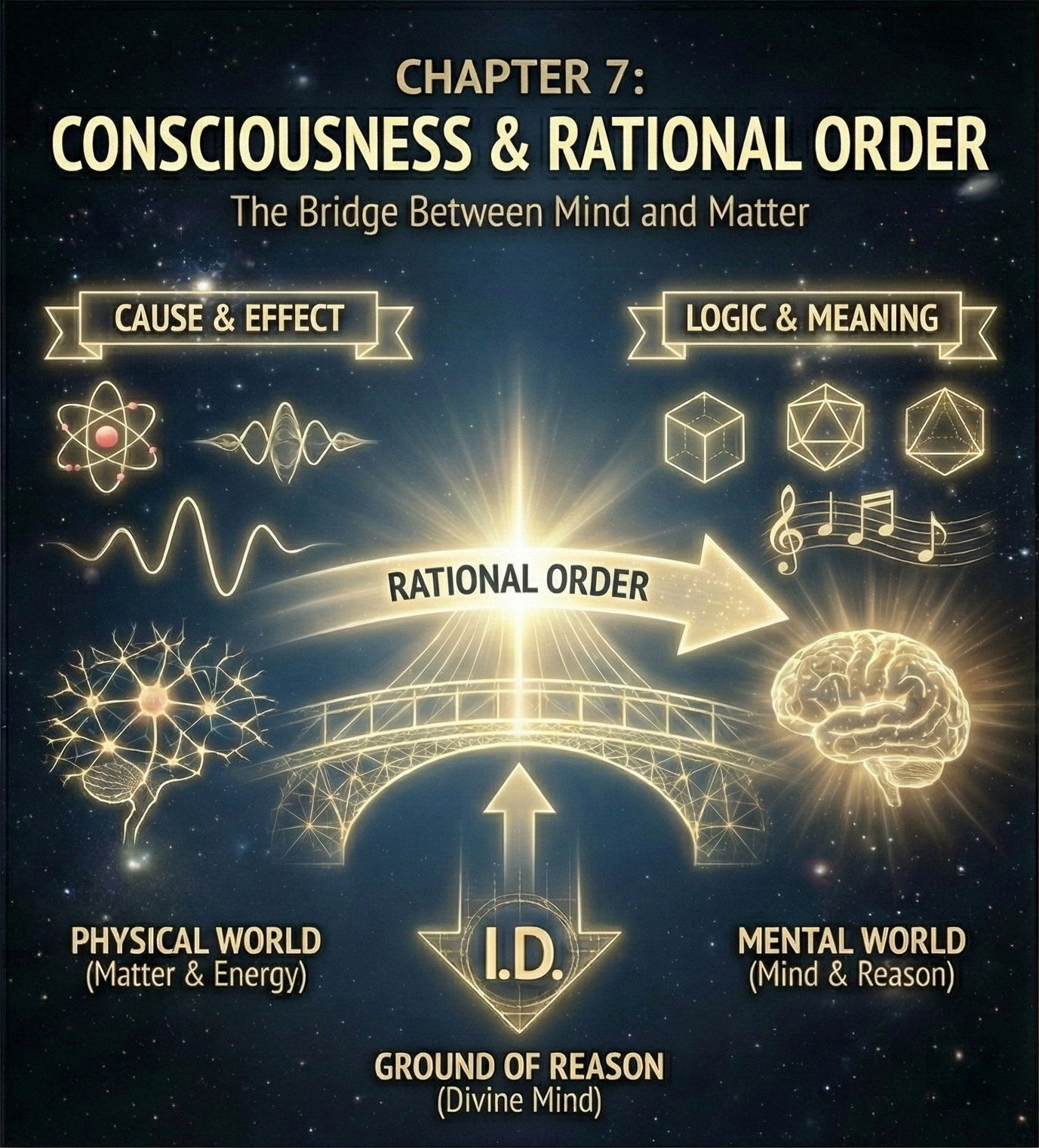
The phenomenon of consciousness presents the most direct evidence for transcendent intelligence embedded within the structure of material reality. David Chalmers' formulation of the 'hard problem of consciousness' demonstrates that subjective experience cannot be reduced to objective physical processes, regardless of their complexity or sophistication. The qualitative nature of conscious states—what philosophers term 'qualia'—exhibits properties that resist materialist explanation.
Consider the phenomenology of mathematical insight. When mathematicians apprehend the truth of theorems, they experience something irreducible to neural computation: the recognition of logical necessity, the appreciation of mathematical beauty, the conviction that proofs reveal eternal structures rather than arbitrary symbolic manipulations. Gödel's Platonist philosophy of mathematics reflects this universal experience among working mathematicians: mathematical objects possess mind-independent reality that conscious subjects can discover but not create.
The neurobiological study of mathematical cognition reveals the inadequacy of computational models for explaining mathematical understanding. Stanislas Dehaene's research on the 'number sense' demonstrates that basic arithmetic abilities emerge from specialized neural circuits, but higher-order mathematical insight transcends any purely mechanistic account. The capacity to recognize infinite sets, to apprehend logical validity, to construct novel proofs—these abilities presuppose cognitive powers that exceed the computational capacities of neural networks.
Some proposals, such as Roger Penrose and Stuart Hameroff's orchestrated objective reduction (Orch-OR), attempt to tie consciousness to non-computable or quantum-gravitational processes in microtubules. These models are controversial and far from accepted as established science. What matters for the argument here is not that any specific speculative model is true, but that even within physics there is a live sense that standard computational or functional models do not exhaust what consciousness and rational insight seem to be doing. If consciousness involves non-algorithmic processes, then conscious beings possess causal powers that transcend the deterministic evolution of classical physical systems.
This suggests what we might term 'top-down causation'—the capacity of conscious states to influence physical processes through mechanisms that violate the causal closure of the physical domain. Such top-down causation appears necessary to explain human rational agency: the ability to evaluate arguments, to recognize logical validity, to choose actions based on reasons rather than mere physical causes.
Alvin Plantinga's evolutionary argument against naturalism demonstrates that naturalistic accounts of cognition face a fundamental reliability problem. If human cognitive faculties arose through purely Darwinian processes, they would be calibrated for adaptive behavior rather than truth-detection. Natural selection operates on survival and reproduction, not rational insight. The fact that human minds can transcend adaptive limitations to discover mathematical truths and logical principles suggests cognitive capacities that point beyond naturalistic explanation.
The fine-tuning of physical law for mathematical comprehensibility reinforces this argument. The universe exhibits exactly the mathematical structure necessary to permit discovery of its own governing principles by finite rational agents. The laws of physics are not merely mathematically expressible—they embody mathematical relationships of extraordinary depth and beauty that seem calibrated for aesthetic appreciation by conscious observers.
This aesthetic dimension of physical law suggests what Alfred North Whitehead termed 'the unreasonable effectiveness of beauty in physical science.' The most fundamental equations of physics—Maxwell's equations, Einstein's field equations, Schrödinger's equation, Dirac's equation—exhibit mathematical elegance that transcends mere utilitarian function. These equations appear designed not merely to govern physical processes but to reward contemplation by rational minds capable of appreciating their formal beauty.
The anthropic fine-tuning of consciousness-permitting conditions extends beyond the fine-tuning of life-permitting conditions to encompass the specific requirements for rational thought. Conscious information processing requires not merely complex neural networks but precisely calibrated thermodynamic conditions that permit stable information integration, error-correcting mechanisms, and hierarchical organization. Whether or not quantum coherence plays a role in consciousness, the stability and functional integration of conscious neural systems depend on multiple coordinated parameters.
The emergence of rational consciousness thus represents the convergence of multiple independent fine-tuning requirements: cosmic parameters that permit complex chemistry, biological parameters that permit neural organization, and thermodynamic parameters that permit coherent information processing. The simultaneous satisfaction of these constraints makes such configurations overwhelmingly disfavored under any model restricted to unguided chance plus blind physical law, relative to the probabilistic resources of our universe. This doesn't yield a formal impossibility proof; it does mean that if we treat our background model seriously, the appearance of such a configuration is powerful evidence for an additional, non-chance explanatory principle.
More profoundly, the correspondence between mathematical structures in conscious minds and mathematical structures in physical reality suggests a fundamental unity underlying the apparent duality of subject and object. The fact that mathematical insights achieved through purely mental activity correspond to the deep structure of external reality indicates that mind and cosmos participate in a common rational order.
This rational order cannot be adequately explained through bottom-up emergence from non-rational material processes. The information-theoretic constraints analyzed in earlier chapters demonstrate that semantic content cannot arise spontaneously from syntactic manipulation. Similarly, rational insight cannot emerge spontaneously from non-rational physical causation, regardless of its complexity or organizational sophistication.
The alternative requires recognizing rational order as fundamental rather than emergent—a primordial feature of reality that manifests itself both in the mathematical structure of physical law and in the rational capacities of conscious minds. Such rational order presupposes what classical theism terms the divine intellect: the eternal source of mathematical truth, logical validity, and rational comprehensibility.
The design inference thus culminates in the recognition that consciousness, cosmos, and comprehensibility form an integrated system that reflects the rational activity of transcendent intelligence. We are not accidents stumbling through a meaningless universe, but rational agents embedded within a cosmic order that has been structured from the beginning to permit, sustain, and reward rational contemplation. The universe bears the signature of Mind because it is the product of the primordial Mind that is the source of all truth, beauty, and rational order.